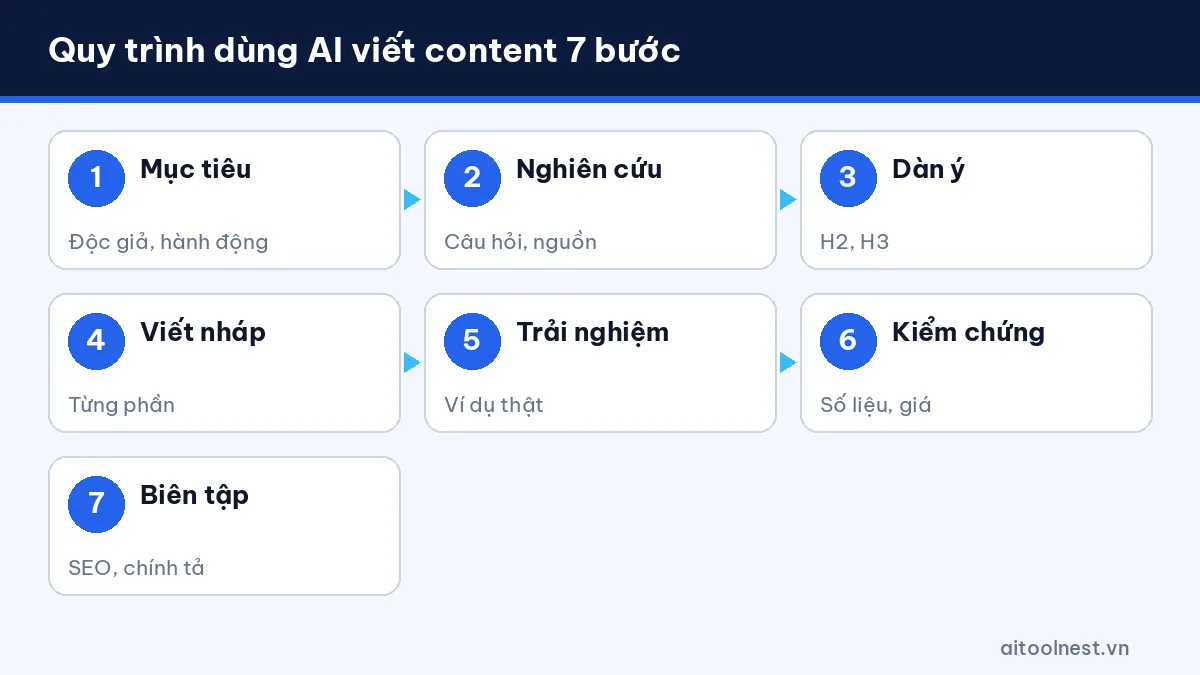
Quick answer: Effective AI content writing isn’t typing “write me an article about X” and publishing it right away. The right process has 7 steps: define your goal and readers → research → outline → draft with AI → add real experience → fact-check → optimize and edit. Popular tools are ChatGPT, Claude and Gemini, all of which have free plans to get started (as of October 2026).
This article is for marketers, online shop owners, freelancers and bloggers who want to use AI to write content faster without sacrificing quality. You’ll get a workflow, a tool comparison table and 20 prompt templates you can copy right away.
Updated: October 24, 2026
Contents
- What AI content writing can and can’t do
- Comparing AI writing tools
- A 7-step workflow
- 20 content writing prompts
- Is AI content good for SEO?
- Common mistakes
- Frequently asked questions
What can AI content writing do, and what can’t it do?
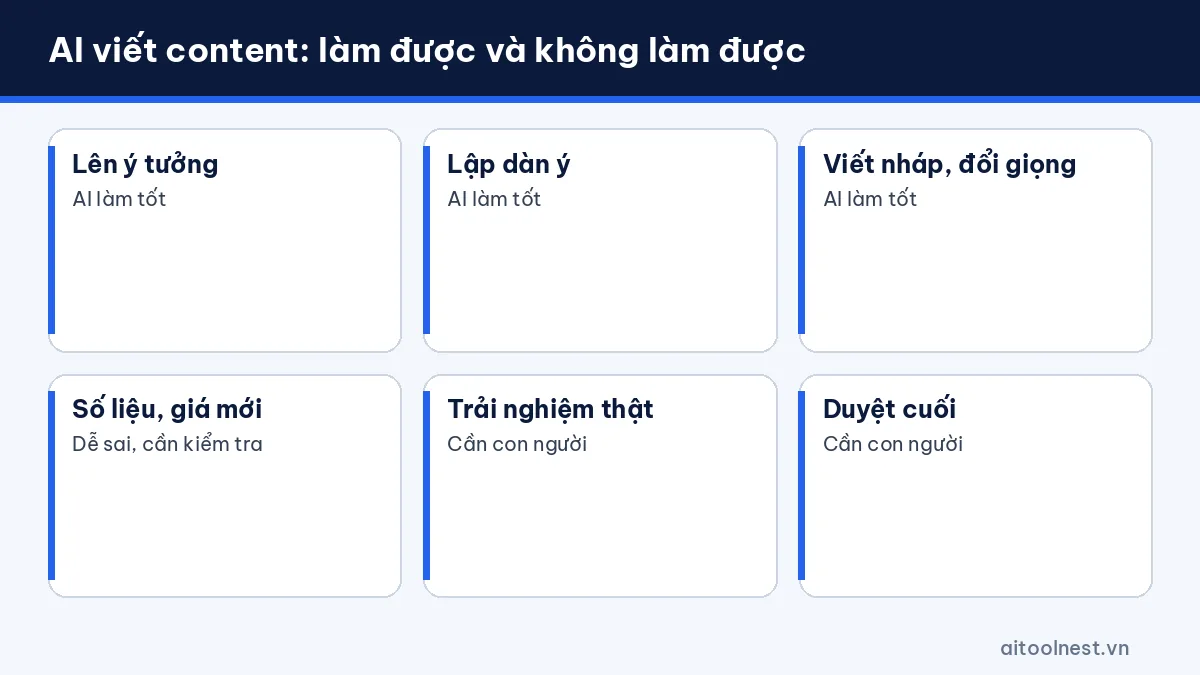
AI is very good at time-consuming, repetitive work: brainstorming, outlining, writing a first draft, rewriting in different tones, shortening or expanding paragraphs and generating multiple headline options.
On the other hand, AI has no real experience with your product, can give outdated or wrong information (“hallucinations”) and tends to write generically when the prompt lacks context. So the writer still has to make the final call on the content.
| Task | AI does well | Needs a human |
|---|---|---|
| Ideas, outlines | ✔ | Choosing ideas that fit the brand |
| Drafting | ✔ | Adding real examples and data |
| Rewriting, changing tone | ✔ | Approving the brand voice |
| Figures, prices, recent events | Error-prone | Checking official sources |
| Experience, reviews | None | Must come from real users |
Comparing popular AI content writing tools
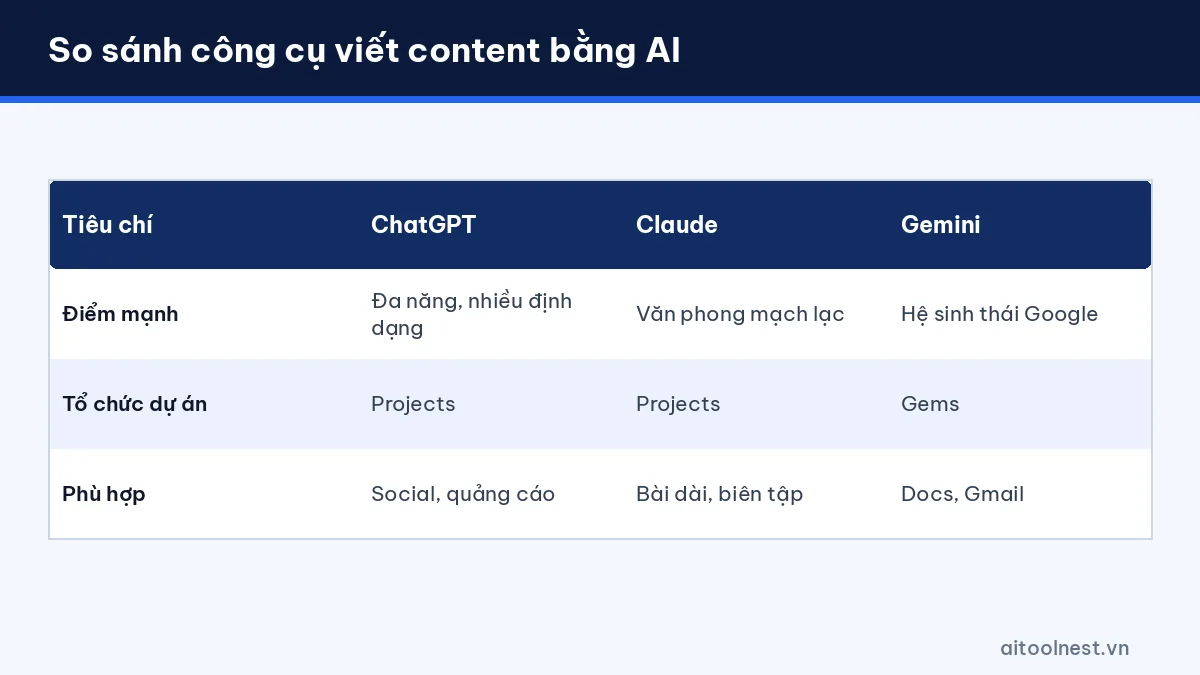
The three general-purpose AI assistants most used for writing are ChatGPT, Claude and Gemini. All three have free and paid plans; prices and limits change often, so check them directly at chatgpt.com/pricing and claude.com/pricing.
| Criteria | ChatGPT | Claude | Gemini |
|---|---|---|---|
| Writing strengths | Versatile, many formats, image generation | Coherent prose, handles long documents | Connected to the Google ecosystem |
| Project organization | Projects | Projects | Gems |
| Best for | Social media, ads, varied content | Long-form articles, editing, rewriting | Google Docs and Gmail users |
For a more detailed comparison, see our ChatGPT vs Gemini article and our ChatGPT review page.
A 7-step AI content writing workflow
Step 1: Define your goal and readers
Answer 3 questions: what is this content for (sales, education, brand building), who’s reading it (age, job, pain points) and what should they do after reading? Put this information into your prompt.
Step 2: Research the topic
Ask AI to list the questions readers often have, then check on Google how the top-ranking pages answer them. Note official sources for any figures you plan to use.
Step 3: Outline
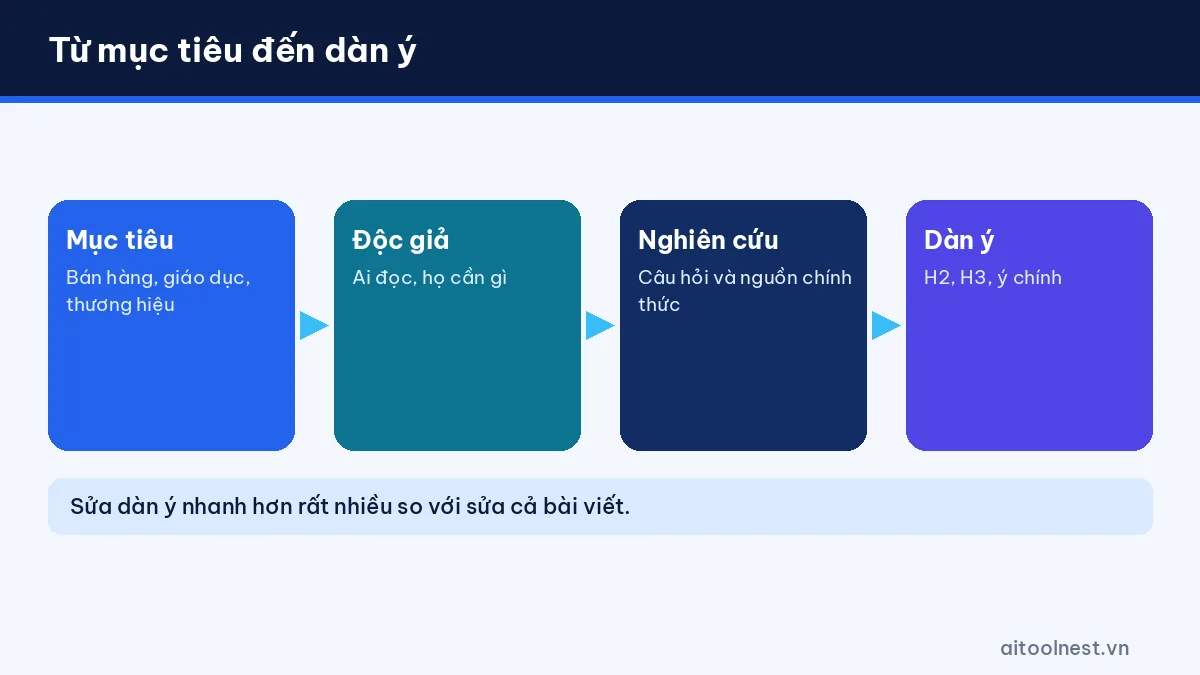
Ask AI to create an outline with H2s, H3s and the key points of each section. Edit the outline before writing, because fixing an outline is much faster than fixing a whole article.
Step 4: Draft section by section
Write one section at a time instead of the whole article at once. This makes the content deeper and makes length easier to control.
Step 5: Add real experience
Add customer examples, product photos, internal data and lessons you’ve learned. This is what sets your content apart, and AI can’t replace it.
Step 6: Fact-check
Check every number, price, product name and date against official sources. Delete or fix any sentences you can’t verify.
Step 7: Optimize and edit
Read the article aloud, cut unnecessary sentences, place your keyword naturally in the title and introduction, add internal links and write a meta description. Finally, check the spelling.
20 content writing prompt templates
Replace the parts in square brackets with your own information. See more prompt-writing principles in our guide on writing clear prompts in 6 steps.
Blogs and SEO
1. List 20 questions [audience] often search for about [topic], grouped by search intent. 2. Create a blog post outline for the keyword "[keyword]" for [audience], with H2/H3 headings and key points for each section. 3. Write an 80-word introduction for the article "" that answers the main question directly in the first 2 sentences. 4. Write the "[H2 heading]" section in about 250 words, with short sentences and 1 real-world example. 5. Suggest 10 titles under 60 characters for the keyword "[keyword]", without clickbait. 6. Write 3 meta description options of 140-160 characters for the article "Lorem ipsum dolor sit amet...
".Lorem ipsum dolor sit amet...
Social media
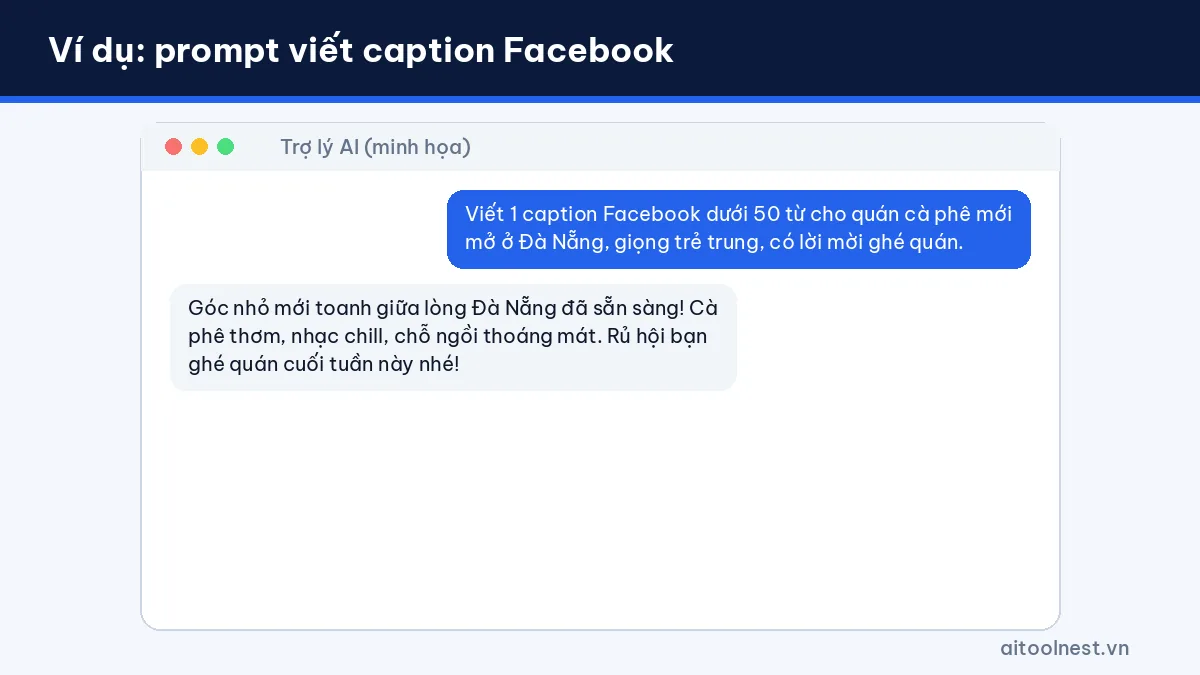
7. Write 5 Facebook captions for [product], each under 80 words, with a call to action.
8. Write a 30-second TikTok script introducing [product]: a 3-second hook, the content and a CTA.
9. Turn the following blog post into 5 short LinkedIn posts: [paste post].
10. Create a 2-week content calendar for a [industry] page, 1 post a day, alternating education, entertainment and sales.
11. Write 10 engaging questions to get more comments on a [industry] page.
Ads and sales
12. Write 5 ads using the AIDA formula for [product], targeting [audience].
13. Write a 150-word product description for [product] with these specs: [paste], focusing on benefits rather than features.
14. Write a sales email to past customers about [offer], with a subject line under 50 characters.
15. Write landing page copy for [service]: headline, 3 benefits, social proof (leave placeholders), FAQ, CTA.
16. Write 3 versions of a post-purchase customer care message for [product].
Editing and optimization
17. Rewrite the following passage in a [friendly / expert / youthful] tone, keeping the meaning: [paste].
18. Cut the following passage to half its length without losing the main points: [paste].
19. List the sentences in the following article that contain information to verify (figures, prices, dates): [paste].
20. Act as a tough editor and point out 5 weaknesses in the following article and how to fix them: [paste].
More prompt templates by industry are on our AI prompts page.
Is AI-written content good for SEO?
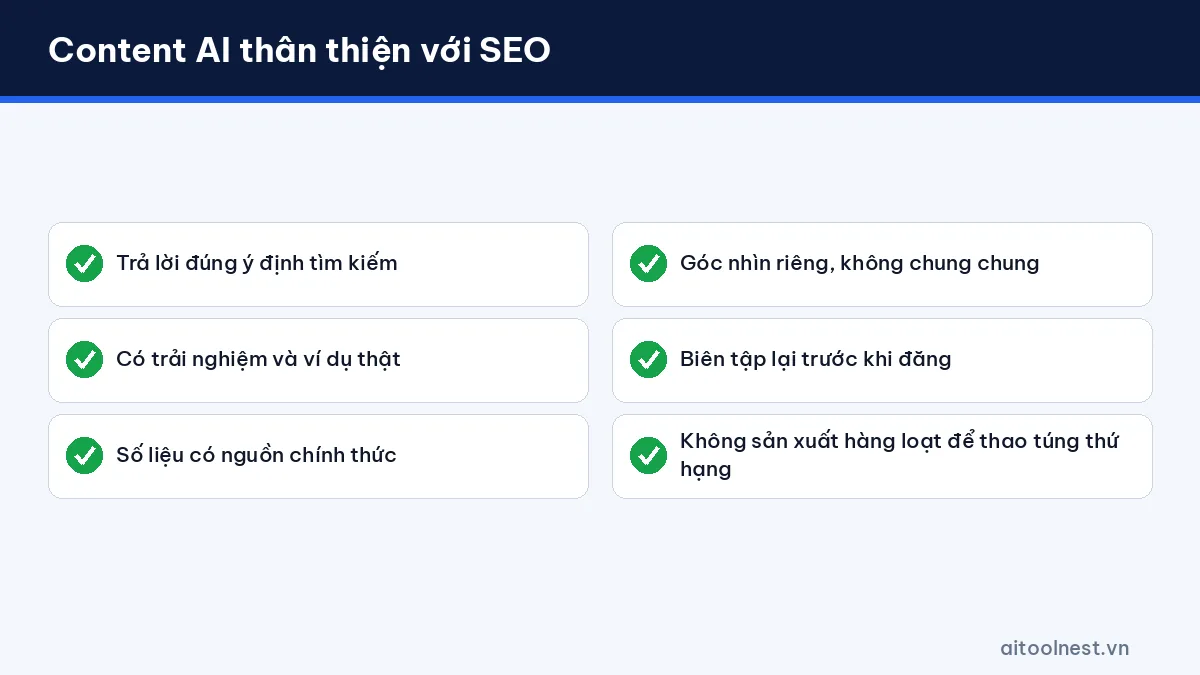
According to Google Search Central’s guidance, Google evaluates content based on its quality and helpfulness to readers, regardless of how it was produced. However, using AI to mass-produce content primarily to manipulate rankings violates its spam policies.
In other words, AI content can rank well if it’s genuinely helpful, accurate and shows real-world experience (E-E-A-T). Articles copied straight from AI that are generic and have no unique perspective will struggle to compete.
Common AI content writing mistakes
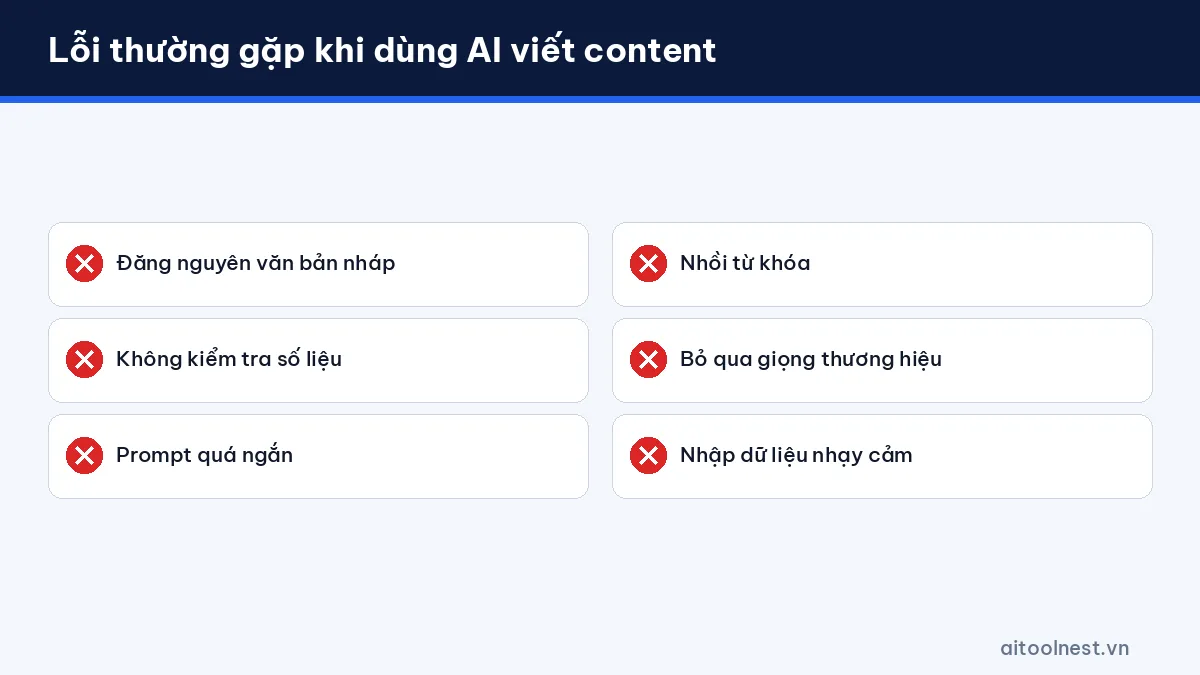
- Publishing the raw draft: repetitive style and lots of filler phrases.
- Not checking figures: AI can make up prices, statistics and quotes.
- Prompts that are too short: without readers, goals and tone, the results are generic.
- Keyword stuffing: asking AI to repeat keywords makes the article hard to read.
- Ignoring your brand voice: every article sounds different and lacks consistency.
- Entering sensitive data: customer information or confidential internal documents.
For more writing and marketing tools, visit our AI writing category.
Frequently asked questions about AI content writing
What’s a good free AI for content writing?
ChatGPT, Claude and Gemini all have free plans that are good enough for basic blog posts, captions and emails (as of October 2026). Try the same prompt on all three to find the writing style you like.
Does Google penalize AI-written content?
According to Google Search Central, Google evaluates content by its quality and helpfulness, not by how it was created. Only content mass-produced mainly to manipulate rankings violates its spam policies.
How do I make AI content sound less robotic?
Give detailed context in your prompt, ask for a specific tone, add real experience and examples, then edit by reading each paragraph aloud.
Should I let AI write the whole article and publish it right away?
No. Use AI for the outline and draft, then add real experience, check the figures and edit before publishing.
What makes a good content writing prompt?
A good prompt clearly states the goal, audience, topic, tone, length and output format, along with any reference material.
Conclusion
AI content writing helps you get from idea to draft many times faster, but the final quality still comes from the writer: understanding readers, bringing real experience and verifying information. Apply the 7-step workflow, save the prompts that work and make AI a steady part of your content production process.
